
Frommer's Travel Guides:
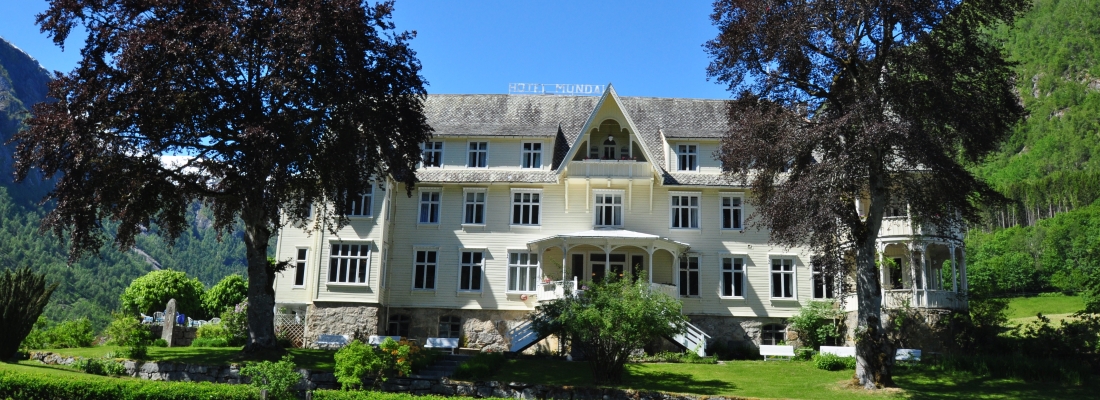
Beloved of landscape painters and glacier hikers for decades, this hotel dates from 1891 and has been operated by the same family ever since. A bit quirky, with its wooden scrollwork, peaked roofs, cavernous dining room, and round tower, it would be the Addams family's hotel of choice if they were traveling the fjord country. Review of Hotel Mundal at Frommer's Travel Guides National Geographic Traveler March Issue 2004: Norwegian Fjords – world’s best travel destination: 115 destinations worldwide
This place has wonderful, living traditional culture, wonderful landscape, not crowded. I am very happy how this destination is managed. Excellent environmental quality, local people involved in a very smooth way. Very good. Source: www.nationalgeographic.com
Travel and leisure, July 2003:
Another 40 minutes and the fjord opens into what looks like a large lake, edged by the loveliest village of the entire sail. This is Mundal, farmland on one side, high mountains on the other. The most distinctive structure in the village is the Hotel Mundal, a turreted, pale-yellow Victorian mansion. We dock here, but before I have time to check out the town and the hotel, we are herded onto a bus that takes us to a glacier museum and then supposedly to the Jostedal Glacier itself. The museum has all sorts of interactive displays and esoteric facts about the phenomenon of slow-moving ice that we call a glacier—but our "close-up" view of Jostedal is more of a medium shot and decidedly underwhelming. Back in Mundal, I hope to have time to explore the village and perhaps have tea. But the boat is departing in five minutes. Quite simply, I don't want to leave this beautiful village. Something clicks inside me and I must now make one of those snap decisions that can affect the outcome of a journey in a major way. It turns out that my return ferry ticket will be good tomorrow, and there's room at the inn. So with no luggage other than a camera bag, I check into the Hotel Mundal. The interior of the place is just as winning as its façade—frescoed parlors feature oiled ceilings, huge leather chairs, an ancient piano, even a few gramophones. My tiny room looks out on fields of grazing cows. Since I have nothing to unpack, I immediately head back downstairs and discover a small café on the premises that also specializes in used mystery novels. The whole town, it turns out—population 300—is known for its 15 secondhand bookshops. These are in cafés, garages, roadside shacks. One is nothing more than a freestanding bin with a collection box where customers deposit the equivalent of $2 to buy a paperback. Evidently, in the late 19th century, Fjaerland—as the area encompassing Mundal is called—was a major destination resort for Scandinavian and, later, British travelers. They came by ship (the only way to get here until 1986, when a road finally linked the area to the rest of Norway) and stayed for several weeks. "In the old days, the farmers took visitors to see the glacier in horse-drawn carriages," says Marit Orhein Mauritzen, the hotel's owner-manager, whose grandparents opened the place in 1891. "So they helped my family finance the hotel because it was good for their business too. Everything at the hotel is pretty much the same as it was a hundred years ago. Even the meals, which are mostly my grandmother's recipes." Breakfast here is the pièce de résistance. It's one of the most amazing spreads I've ever seen (Grandma would definitely be proud): salmon, herring, shrimp, fish mousses and pâtés, six varieties of cheese, ham, salami, compotes, cereals, yogurts, beets, tomatoes, eggs sprinkled with caviar. Where to start? Worse, when to stop? Source: www.travelandleisure.com Article: Bergen and Beyond Travel and leisure, May 2003
The Jostedal, one of Europe's largest glaciers, is only six miles from tiny Mundal. But that doesn't worry this small farming village in the Fjærland Valley. Indeed, the inhabitants have celebrated their proximity to the mountainous ice mass with the stunning concrete-and-glass Norwegian Glacier Museum, designed by Pritzker Prize-winning Norwegian architect Sverre Fehn. Mundal also has dozens of multilingual bookshops set up in old barns and boathouses throughout town. Source: www.travelandleisure.com Article: 25 Secret European Villages Lonely Planet 2002:
"This excellent upmarket option, built in 1891 and run by the same family ever since, features a lovely round tower and a welcoming lounge.." ("Lonely Planet; Norway"; Lonely Planet Publications Pty Ltd 2002, p. 275) The farming village of Fjærland, at the head of the scenic Fjærlandsfjord, lies near two particularly accessible glacial tongues, Supphellebreen and Bøyabreen. For that reason, it's one of Norway's best attended sites, attracting upwards of 100 000 visitors a year. In 1996 however, hoping to diversify its tourist appeal, Fjærland declared itself the "Book Town" of Norway. Now this tiny place boasts around 14 shops selling a wide range of used books mostly in Norwegian but also in english, Frendh, German and other languages. An annual book fair is held on the Saturday nearest 23 June." (Lonely Planet; Norway; Lonely Planet Publications Pty Ltd 2002, p. 273). Academic Cooperation Association, ACA Annual Report 2001: Brussels June 2002 "2001 also saw a highly successful ACA seminar take place among the fjords and glaciers of Norway, exploring the theme of "virtual mobility and cooperation". It not only resulted in another publication in our own series, the ACA Papers on International Cooperation and Education. It also witnessed the birth of a new formula for international events: selective in participation, high in quality, and held in a serene environment stimulating reflection and networking. The "Fjærland Formula". Due to the great success of the "Fjærland formula", ACA will hold a seminar of the same design again in the spring of 2002. …….. The Fjærland formula means a non-capital-city location, offering the relaxed and unhurried atmosphere condusive to thorough intellectual probing and successful networking, and a culinary and touristic by-programme of the first order." |